WWI Wooden Laminated Propeller & clock
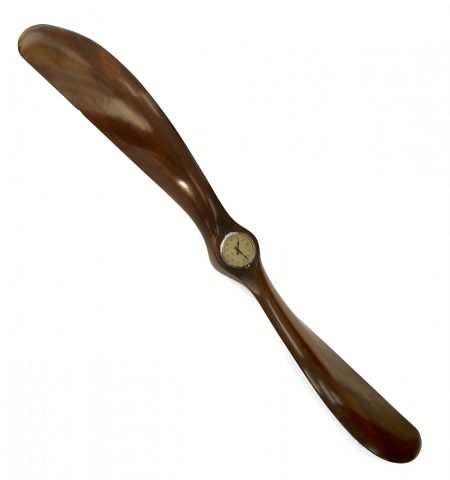
WWI-wooden-propeller-IPC

A very rare and graceful laminated wooden propeller made by the Integral Prop Company. The propeller was used on a 90 horse power Royal Aircraft Factory engine 1, with a DH6 aircraft, whose stability enabled it to become an all-weather anti-sub aircraft when the U-Boat menace became a danger to Great Britain in 1917.

With a length of just over 9 feet (278cms), this will be a dominant feature on any wall and an interesting talking point. The clock is an early Mercer electrical clock, giving almost silent operation.

The underside of the hub is stamped
IPC 23770
D278 (indicating a diameter of 2.78 m)
P330 (indicating a pitch of 3.30m)
HP 90 RAF

DE H 6 (Arco deHavilland 6)
G586 N65 (indicating the sixty-fifth prop in batch 586)
50887  (the serial number of IPC).

This information was gleaned from Bob Gardner, whose excellent website www.woodenpropeller.com is a mine of information. Thanks Bob! Another propeller from batch G583 Bob dates to autumn of 1917, so this one was presumably made very shortly afterwards.

The front of the propeller is also stamped with a military insignia.

The timepiece clock is from a bulkhead marine clock by Mercer from around 1930.  Originally a slave clock , it is now retro-fitted with a slave impulser to run independently. It is powered by a standard 1.5-volt batteries, concealed within the hub.

The silvered 6-inch dial has Arabic numerals within a minute- track and is signed MERCER, ST. ALBANS, ENGLAND.
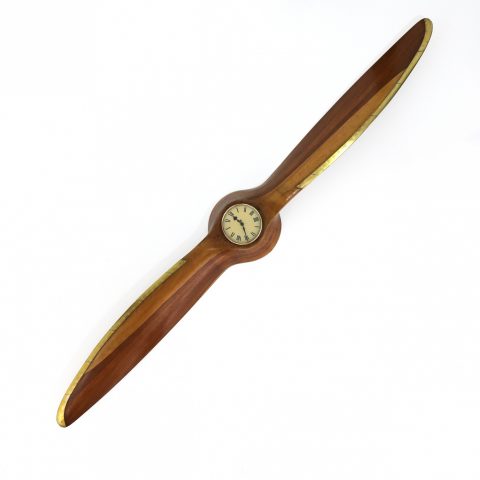
1935 De Havilland wooden Gipsy VI Propeller and clock

Wooden-Propeller-clock

An original two-bladed brass-edged wooden propeller from a De Havilland Gipsy VI, retro fitted with a mid 20th century timepiece clock.

The Propeller

The Gipsy VI was used on light sports aircraft from the 1930s including the de Havilland Moths. The base of the hub is mounted with a brass plate stamped DRG No DH 5238/F/9 GIPSY VI LH‘ and ‘D6 75 P6 3 JUNE 35 AC 38149.

The blades are brass edged on the leading side for protection. The laminated wood has been polished, and the propeller blades remains in very good original condition.

The Clock

The mid 20th century clock has been retro fitted into the hub. It has an English made electro-magnetic movement, powered by a standard battery.

The clock has matching black steel hands to the cream opainted dial. The movement is to be overhauled and will be guaranteed for 3 years.


  • Overall length: 6 feet 3 inches (190cms)


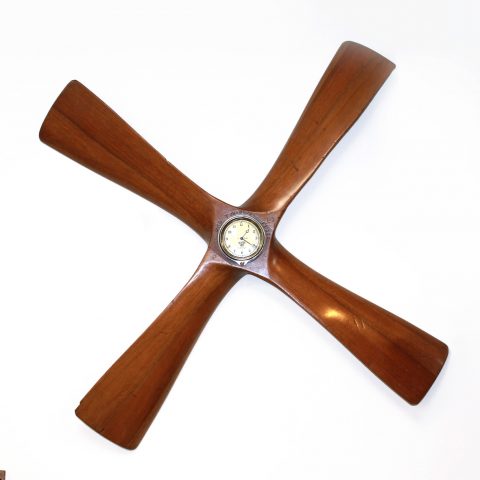
1940s wooden four-blade propeller clock

wooden-propeller

A genuine four-bladed laminated wood propeller, c.1940s, retro-fitted with a dashboard clock by Smiths, from the same era.

The hub is stamped with the DRG number T29505/2, and 11220.

Bob Gardner from the woodenpropeller.com forum gives the following information about this propeller:

a winch propeller from a target tug aircraft, most probably a WW2 aircraft. When not in use it rested inside the fuselage of the aircraft.

The aircraft towed the target drogue off the ground and when required for target practice, this prop was lowered into the airstream to provide the power for the winch which let out the drogue quite a long distance behind the aircraft; at least several hundred yards; sometimes nearly a mile.

The letter T on the drawing number indicates the authority that designed it, the Royal Aircraft Establishment.

The mechanical clock is bezel wound, and has a pull-out knob at the front to set the hands.

It is overhauled and guaranteed for 3 years.


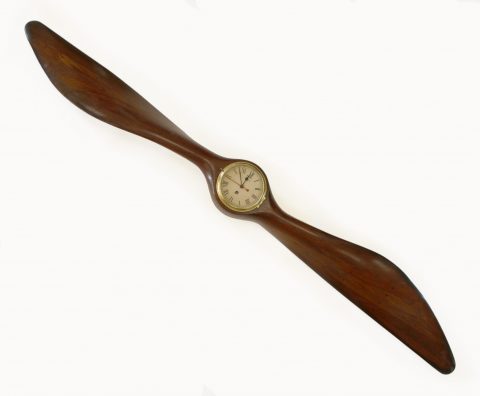
Biplane Wooden Aircraft Propeller with clock

Wooden-propeller-clock

A 1917 wooden aircraft propeller from a World War I Royal Flying Corps Scout Experimental 5, one of the fastest British biplane fighter aircraft of the first World war, and also one of the most agile.

The propeller is a fine wooden sculpture, and would be a great decorative feature to any wall, vertically, horizontally, or at any angle you please. The clock can be twisted within the hub to suit.

The propeller is branded to the hub T28066 Trevor Page & Co Ltd, 150HP Hispano Suiza SE5 T5.

It also has makers decals to each blade, and a (barely discernable) crow’s foot mark indicating its history in the British military forces.

The hub has now been fitted with an 8-day mechanical English Smiths bulkhead ships clock, with a red centre seconds hand. The Coventry Astral movement no. 288 has a platform escapement.

The 6-inch dial sits behind a heavy cast brass hinged bezel.

Trevor Page & Co Norwich, were upholsterers and cabinet makers, clearly called upon to manufacturer propellers for the war effort.

The clock is overhauled and guaranteed for 3 years.

Overall length, tip to tip: 234cms

The photo of the Scout Experimental 5A is The Shuttleworth Trust’s SE5A at Old Warden’s Summer Show 2009 [courtesy TSRL – Own work, CC BY-SA 3.0, https://commons.wikimedia.org/w/index.php?curid=7054875]


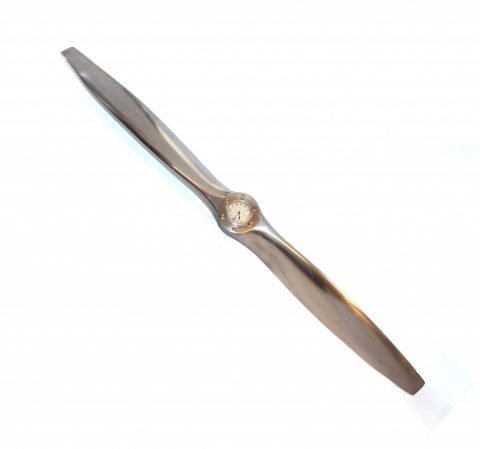
Early 1960s Sensenich Propeller Clock

Sensenich airplane propeller, Model: M74DM, serial number A33067.

This genuine aluminium alloy aircraft propellor has a length of 74″, the hub now housing an early-mid C20th timepiece mechanical clock.

The original paintwork can be seen on several of the images, but this has now been stripped and the aluminium polished to give a modern bright finish.

The clock has a rear-wound platform escapement of 8-day duration. It removes easily from the case by twisting four of the retaining nuts which secure the chrome bezel. The white enamel dial has a 3-inch diameter, with Arabic numerals within an outer minute track.

Unfortunately, the history of the propeller is unknown.

The clocks mechanism is to be overhauled and guaranteed for 3 years.

The overall length is 188cms; the clock may just as well be placed within the hub such that the propeller is vertical, or indeed at any angle on the wall.

Price includes delivery within mainland UK.